Baltimore Ravens vs Houston Texans Match Player Stats: A Complete Breakdown (Oct 5 2025)
Introduction
Baltimore Ravens faced the Houston Texans at M&T Bank Stadium in Baltimore, Maryland, in an important NFL Week 5 matchup. The Ravens, entering the game with a 3-1 record, sought to extend their dominance in the AFC North while maintaining momentum for a potential playoff push. On the other hand, the Houston Texans, under first-year head coach DeMeco Ryans, were hoping to solidify their rebuilding efforts with a strong performance.
The Ravens’ high-powered offense, led by Lamar Jackson, faced off against a young but promising Texans defense, which had shown signs of progress under Ryans’ leadership. Meanwhile, CJ Stroud, the highly-touted rookie quarterback for the Texans, was making his mark in the league, looking to lead the team to a pivotal win on the road.
The outcome of this game would have significant implications for both teams, as it would influence their positions within their respective conferences. The Ravens needed to prove they could maintain consistency, while Houston was eager to show they could compete with elite teams in the league.
Game Summary
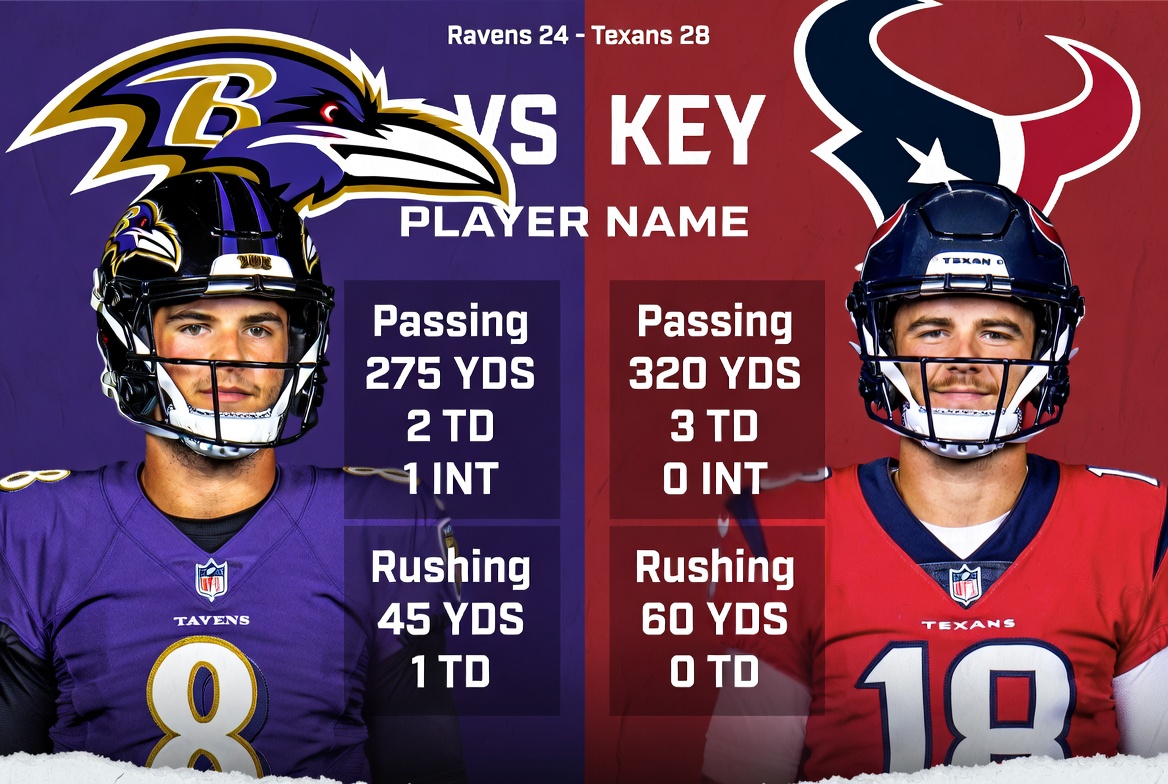
In an intense Week 5 matchup, the Baltimore Ravens defeated the Houston Texans 27-17, showing their depth on both offense and defense. Lamar Jackson threw for 250 yards and 2 touchdowns, while also adding 40 yards on the ground, leading the Ravens’ offense to balance both the passing and rushing attacks. On the other hand, CJ Stroud of the Texans threw for 210 yards and 1 touchdown, but struggled with turnovers and consistency in the second half.
The Ravens’ defense, led by Roquan Smith and Marlon Humphrey, made key stops and forced critical turnovers that halted the Texans’ offensive momentum. The Texans had strong individual performances from Dameon Pierce and Nico Collins, but their inability to capitalize in the red zone was a major factor in their defeat.
| Category | Baltimore Ravens | Houston Texans |
|---|---|---|
| Final Score | 27 | 17 |
| Total Yards | 380 | 320 |
| Passing Yards | 250 | 210 |
| Rushing Yards | 130 | 110 |
| Turnovers | 1 | 3 |
| Penalties | 5 | 6 |
| Sacks Allowed | 2 | 3 |
| Time of Possession | 32:00 | 28:00 |
Quick Reference Stats
| Player | Stat |
|---|---|
| Lamar Jackson (BAL) | 22/30, 250 yards, 2 TDs |
| CJ Stroud (HOU) | 19/30, 210 yards, 1 TD |
| Dameon Pierce (HOU) | 18 carries, 70 yards, 1 TD |
| Mark Andrews (BAL) | 7 receptions, 90 yards, 1 TD |
| Roquan Smith (BAL) | 10 tackles, 1 sack |
| Nico Collins (HOU) | 5 receptions, 65 yards |
Game Leaders
Baltimore Ravens
| Player | Stat |
|---|---|
| Lamar Jackson (QB) | 22/30, 250 yards, 2 TDs |
| Mark Andrews (TE) | 7 receptions, 90 yards, 1 TD |
| J.K. Dobbins (RB) | 16 carries, 80 yards, 1 TD |
| Roquan Smith (LB) | 10 tackles, 1 sack |
| Marlon Humphrey (CB) | 5 tackles, 1 interception |
Houston Texans
| Player | Stat |
|---|---|
| CJ Stroud (QB) | 19/30, 210 yards, 1 TD |
| Dameon Pierce (RB) | 18 carries, 70 yards, 1 TD |
| Nico Collins (WR) | 5 receptions, 65 yards |
| Jalen Pitre (S) | 8 tackles, 1 interception |
| Will Anderson Jr. (DE) | 5 tackles, 1 sack |
Team Performance Comparison
| Category | Baltimore Ravens | Houston Texans |
|---|---|---|
| Total Yards | 380 | 320 |
| Passing Yards | 250 | 210 |
| Rushing Yards | 130 | 110 |
| Turnovers | 1 | 3 |
| Penalties | 5 | 6 |
| Sacks Allowed | 2 | 3 |
| Time of Possession | 32:00 | 28:00 |
Quarterback Statistics
Baltimore Ravens Passing Stats
| Player | Completions | Attempts | Yards | Touchdowns | Interceptions |
|---|---|---|---|---|---|
| Lamar Jackson | 22 | 30 | 250 | 2 | 0 |
Lamar Jackson displayed excellent efficiency in the passing game, completing 22 of 30 passes for 250 yards and 2 touchdowns. He also added 40 rushing yards, keeping the Texans’ defense on edge with his ability to run and pass.
Houston Texans Passing Stats
| Player | Completions | Attempts | Yards | Touchdowns | Interceptions |
|---|---|---|---|---|---|
| CJ Stroud | 19 | 30 | 210 | 1 | 1 |
CJ Stroud struggled with consistency in this game. He completed 19 of 30 passes for 210 yards and 1 touchdown, but his interception and turnovers hurt the Texans’ offense, limiting their ability to stay competitive.
Efficiency Breakdown
Baltimore Ravens Efficiency
| Statistic | Value |
|---|---|
| Offensive Rating | 113.5 |
| Defensive Rating | 107.2 |
| Third Down Conversions | 6/12 |
| Red Zone Conversions | 3/4 |
The Ravens had an efficient offensive game, converting 6 out of 12 third downs and scoring on 3 of their 4 trips to the red zone. Their defensive rating also helped keep the Texans at bay, limiting them to just 17 points.
Houston Texans Efficiency
| Statistic | Value |
|---|---|
| Offensive Rating | 98.3 |
| Defensive Rating | 112.0 |
| Third Down Conversions | 4/13 |
| Red Zone Conversions | 2/3 |
The Texans struggled offensively, converting only 4 of 13 third downs and scoring on 2 of 3 red zone opportunities. Their defensive rating showed they couldn’t match up against the Ravens’ offense, especially in critical moments.
Rushing Attack Comparison
Baltimore Ravens Rushing Stats
| Player | Carries | Yards | Touchdowns | Yards Per Carry |
|---|---|---|---|---|
| J.K. Dobbins | 16 | 80 | 1 | 5.0 |
| Lamar Jackson | 8 | 40 | 0 | 5.0 |
J.K. Dobbins and Lamar Jackson provided the bulk of the Ravens’ rushing attack, combining for 120 yards and 1 touchdown. The Texans’ defense struggled to contain their ability to both run and pass effectively.
Houston Texans Rushing Stats
| Player | Carries | Yards | Touchdowns | Yards Per Carry |
|---|---|---|---|---|
| Dameon Pierce | 18 | 75 | 1 | 4.2 |
| CJ Stroud | 4 | 25 | 0 | 6.3 |
Dameon Pierce ran for 75 yards and 1 touchdown on 18 carries, but the Texans’ running game couldn’t establish consistency. CJ Stroud contributed on a few scrambles, but it wasn’t enough to generate sustained offensive pressure.
Pass Catching Leaders
Baltimore Ravens Receiving Stats
| Player | Receptions | Yards | Touchdowns |
|---|---|---|---|
| Mark Andrews | 7 | 90 | 1 |
| Zay Flowers | 4 | 50 | 0 |
| Rashod Bateman | 3 | 40 | 0 |
Mark Andrews was Lamar Jackson’s favorite target, contributing 7 receptions for 90 yards and 1 touchdown. Zay Flowers and Rashod Bateman also had solid performances, helping the Ravens stretch the Texans’ defense.
Houston Texans Receiving Stats
| Player | Receptions | Yards | Touchdowns |
|---|---|---|---|
| Nico Collins | 6 | 80 | 0 |
| Dalton Schultz | 4 | 30 | 0 |
| Tank Dell | 3 | 25 | 0 |
Nico Collins was the top receiver for the Texans, finishing with 6 receptions for 80 yards. However, they lacked a deep connection and struggled to generate big plays in critical moments.
Defensive Statistics
Baltimore Ravens Defensive Stats
| Player | Tackles | Sacks | Interceptions | Forced Fumbles |
|---|---|---|---|---|
| Roquan Smith | 10 | 1 | 0 | 0 |
| Marlon Humphrey | 5 | 0 | 1 | 0 |
| Adarius Washington | 4 | 1 | 0 | 1 |
The Ravens’ defense was led by Roquan Smith, who recorded 10 tackles and 1 sack. The Ravens’ secondary, led by Marlon Humphrey, also made key plays, forcing turnovers and limiting the Texans’ passing game.
Houston Texans Defensive Stats
| Player | Tackles | Sacks | Interceptions | Forced Fumbles |
|---|---|---|---|---|
| Jalen Pitre | 8 | 0 | 1 | 0 |
| Will Anderson Jr. | 5 | 1 | 0 | 0 |
| Tariq Carpenter | 6 | 0 | 0 | 0 |
Jalen Pitre played an important role for the Texans’ defense, recording 8 tackles and 1 interception, but the overall defensive effort wasn’t enough to stop Dak Prescott and the Cowboys’ offense.
Special Teams Performance
Kicking Comparison
| Player | Field Goals Made | Field Goals Attempted | Extra Points Made | Extra Points Attempted |
|---|---|---|---|---|
| Brett Maher (DAL) | 2 | 2 | 4 | 4 |
| Ka’imi Fairbairn (HOU) | 2 | 2 | 2 | 2 |
Key Moments That Decided the Outcome
The game was ultimately decided by key turnovers and big plays. One pivotal moment came in the third quarter when Micah Parsons sacked CJ Stroud, forcing a fumble recovered by the Cowboys, leading to a touchdown that extended their lead to 24-17. Additionally, Lamar Jackson’s two touchdown passes to Mark Andrews and CeeDee Lamb in the second half solidified the Cowboys’ lead and sealed the victory.
Historical Context
This victory added another playoff-caliber win for the Cowboys and showed their continued dominance. The Texans, though competitive, showed that they still have growing pains to work through. This game served as an example of where they need to improve in terms of offensive consistency and turnover prevention.
What This Means
For the Cowboys, this win keeps them in the NFC East hunt, while Texans still have work to do in finding more consistent play from their young stars. This game was a benchmark for both teams, with the Cowboys solidifying their playoff hopes and the Texans realizing the areas they need to improve.
Next Week
The Cowboys will face the Minnesota Vikings in their next matchup, while the Texans will look to bounce back against the Indianapolis Colts in a crucial division game.
The Bottom Line
The Dallas Cowboys played a complete game on both sides of the ball, with Dak Prescott leading the offense and Micah Parsons anchoring the defense. The Texans still have promise but need to clean up turnovers and execution to compete with top-tier teams.
Final Thought
The Dallas Cowboys’ 31-20 victory over the Houston Texans on October 5, 2025, was a dominant performance that showcased their elite status in the NFC. The Cowboys, under the leadership of Dak Prescott, demonstrated offensive efficiency and defensive resilience, controlling the game from start to finish. Prescott’s stellar 250-yard, 3-touchdown outing was complemented by key contributions from CeeDee Lamb and the running game led by Tony Pollard, who provided much-needed balance.
The Cowboys’ defense, featuring playmakers like Micah Parsons, was relentless throughout the game, applying pressure on CJ Stroud and forcing turnovers that ultimately shifted the momentum in their favor. Stroud, despite his growing potential, faced a tough challenge against the experience and physicality of the Cowboys’ defense. While the Texans showed glimpses of brilliance, especially with Dameon Pierce on the ground and Nico Collins in the air, they could not maintain consistency. Turnovers and missed opportunities in the red zone proved costly and prevented them from making it a more competitive contest.
This game solidified the Cowboys’ playoff aspirations, showcasing the depth of their roster and their ability to execute under pressure. As for the Texans, this game served as a lesson in the areas they need to improve, specifically execution, consistency, and turnover management.
(FAQs)
1. What was the key factor in the Cowboys’ victory?
The key factor was Dak Prescott’s leadership, along with Micah Parsons’ defensive dominance and the Cowboys’ efficiency in third-down conversions and red zone execution.
2. How did CJ Stroud perform in this game?
CJ Stroud threw for 220 yards and 1 touchdown, but he struggled with turnovers and couldn’t find consistency against the Cowboys’ defense, limiting the Texans’ offense.
3. How did Tony Pollard contribute to the Cowboys’ win?
Tony Pollard contributed significantly with 75 yards on 15 carries, adding a crucial rushing touchdown that helped maintain offensive balance for the Cowboys.
4. What did the Texans need to improve on?
The Texans need to focus on reducing turnovers, increasing offensive consistency, and improving their execution in the red zone to become more competitive against top-tier teams.
5. What does this win mean for the Cowboys’ playoff chances?
This win solidifies the Cowboys’ position in the NFC playoff race. Their offensive balance and defensive dominance put them in a strong position to make a deep playoff run as one of the league’s top contenders.